
The Quick and the Dead
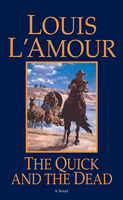
When Susanna stepped down from the wagon Duncan had the fire going, but he sat staring in the flames, forearms resting on his knees, hands hanging loose.
"Duncan?" She was a slender, graceful and usually pretty woman. "Duncan? What is it?"
"It's this. . . all of it." His gesture took in their surroundings. "I had no right to bring you and Tom into this, no right at all."
"We discussed it, Duncan. We all took part in the decision. We all decided it was the best thing."
"I know, Susanna, but that was back east. It was one thing to sit in a comfortable living room and talk about the west, but it's something else when you are face to face with it." He looked westward, toward the open plains. "What's out there, Susanna? What are we getting into.?"
"Somebody's coming, Pa." Tom was twelve. If his father had doubts, he had none.
They looked where he pointed. A rider was coming through the scattered trees toward them. He was a tall, rough-looking man on a roan horse and he carried his rifle as if he was born with it.
He pulled up some fifty yards off. His eyes swept the camp. "Howdy. All right if I come in?"
There was nothing about his looks to inspire confidence but Duncan McKaskel said, "Come on in. It's all right."
He rode up, stopping across the fire from their wagon, dismounting with his horse between himself and the fire.
"Seen your smoke. Figured you might have coffee."
"Be seated. Breakfast will soon be ready."
I am Duncan McKaskel. My wife Susanna, my son, Tom."
"Howdy."
He added a stick to the fire, glancing at the wagon and the deep-cut tracks. "You got quite a load there. Ain't goin' far, I guess."
"We will manage," Duncan's tone was cool.
"Good coffee," He reached for the pot and refilled his cup. "Ever driven on the prairie? I mean where there's no road."
"No, I haven't."
"You ain't goin' far with just four mules an' a load that heavy. An' s'posin' your mules wander off? How'll you find `em?"
"We have riding horses."
The stranger sipped his coffee. "Not no more, you don't. They've been took."
"What's that?"
"You had a pair a sorrels? Big, handsome horses?"
"Yes."
"Then you don't have them no longer. They been stole. A couple of fellers drove them off just before full light. Fellers from the settlement, yonder."
"I don't believe --" McKaskel started to move off, then glanced from the stranger to Susanna. He stopped. "Tom, you run and check on the horses."
Susanna was slicing bacon into the frying-pan, her face flushed from the heat. "You're a mighty handsome woman, ma'am."
"Thank you."
"When you crossed the river, yonder? You come right up through the settlement?"
"We stopped there." McKaskel decided he did not like this man.
"Figured you had. They seen your stock, and they seen your woman."
"What do you mean by that?"
"That's a mean outfit. Small caliber, but mean. They seen that heavy-loaded wagon, your wife, an' your stock. They mean to have them."
Tom came running, his face white. "Pa! The horses are gone! There's tracks. . . right across that sandy place toward those shacks."
"Duncan. . . ?" Susanna was frightened.
"I must have those horses. I'll just walk over and see if I can find them."
The stranger picked two slices of bacon from the skillet. Without looking up he said, "You ever kill a man, McKaskel?"
"Kill a man?" McKaskel was startled. "Why, no I haven't."
"You walk into that settlement with that gun an' you better figure on it."
"I don't think--"
"You walk into that place without bein' ready to kill an' your wife'll be a widow before the hour's gone."
"That's nonsense. I'll go to the law."
"Ain't none. Folks out here generally make their own."
"I can use the rifle. I've killed a dozen deer--"
"Was the deer shootin' back at you? Mister, that outfit figure on you comin' in. They want you to. Why do you s'pose they left all them tracks? They figure to kill you, Mister."
"So what am I to do? Let them steal my horses."
"Uh-uh. You just go in there with your eyes open, figurin' you're goin' to have to kill somebody. You spot you a big fat man, an' when you start talkin' you just sort of careless-like get your rifle pointed at him. Then you tell them to trot out your horses."
"Duncan? Don't do it. It isn't worth it. Not for two horses."
"We raised those horses, Susanna, and they belong to us. I shall go after them."
"You better. . . while the notion's on you. You just go right on in, an'don't you worry none about your woman, here. Anything happens to you an' I'll take care of her. I'll do just that."
"Now, see here." McKaskel hesitated, glancing from one to the other.
"Duncan," Susanna said quietly, "if it must be done, do it, and do not worry about me. I will be alright."
"Pa? Can I go with you? I can shoot!"
"You stay with your mother."
He took up his rifle and strode out of camp. His mouth was dry and he was frightened.Only three hundred yards to the shacks, and he did not know whether he wished it were nearer or farther. He had seen the men sitting on the saloon porch as he and his family came through and he had been glad to leave them behind.
He thought of his rifle. It was a good one, and he could shoot straight, but he had never shot at a man. Could he do it now?
The shacks were there, right in front of him. The horses were there, too, tied right to the rail in front of the saloon. No attempt had been make to conceal them. They were a challenge, an affront.
He could see two men seated on a rough bench, another standing in the door, and they had seen him coming. He could not turn back now. They would know that he was afraid.
The stranger was right. They planned to kill him.
Back at the fire the stranger emptied his cup. Susanna's features were white and strained. "Well," the stranger said, "you better make your plans. He went in an' I wouldn't give a busted trace-chain for his chances. You're goin' to be a widow, ma'am. Now I ain't much, but--"
"You're going to let him be killed?"
"None of my affair."
"Help him."
"You his woman?"
"We are married."
"Wasn't what I asked. I wanted to know if you was his woman? It ain't always the same thing."
"I am his woman and am proud to be so. He is a fine man. An I am a decent woman."
Lazily, he got to his feet and moved to his horse. "I'll just mosey on in an' see the fun." He swung into the saddle. "Of course, if he gets himself killed, you got you a choice. . . me or them."
"I shall go back home." Susanna replied. "I am sure Tom and I could get along."
He grinned at her and swung his horse. As soon as emerged from the trees he could see McKaskel walking into the street. The stranger turned his horse to use the cover of the trees and came up to the town at an angle from which he could not be seen. Drawing up in the shade of the tree, he drew his rifle from its scabbard.
He could hear McKaskel speaking. "I see you found my horses. Thank you for holding them for me."
The thin man who answered him seemed amused. "Your horses, you say? Now how would we know that? Those horses come driftin' in, an' my boys tied them up. We figure to keep them."
"They belong to me. I have their papers."
The man grinned lazily, a taunting grin. "Papers? Now, ain't that too bad? I cain't read, Mister. I just cain't make out them words. . . neither can my boy."
McKaskel remembered what the stranger had said. The fat man was lounging in the doorway. McKaskel shifted his feet slightly, and managed to turn the muzzle of his gun, an easy, natural movement, but suddenly it was there, covering the fat man.
"I shall take my horses. I am sure you will thank your son for me, but tell them we reared these horses and we must keep them."
He stepped toward the horses.
The thin man spat lazily. "Mister, was you to untie them horses somebody might get the idea you was tryin' to steal them. You ready to get yourself shot?"
McKaskel kept his eyes on the fat man as he spoke to the thin one. "Even if I was to get shot I'd still pull this trigger, and I couldn't miss that man standing in the door."
The rifle titled ever so little, and he kept the fat man covered as he pulled the string to untie the knot.
"Don't nobody do nothin' foolish!" The fat man shouted the words. "Let `im go!"
Holding the rifle steady, Duncan McKaskel put a foot in the stirrup and swung to the saddle. Turning his horse he untied the second horse, keeping his rifle in position as he did so.
He backed the horses into the street, keeping the rifle on the fat man, but as he turned the horses his rifle swung off target and on the instant the fat man disappeared into the saloon and the men on the porch threw themselves right and left, one of them scrambling toward the open door.
There were two shots.
He felt the whiff of the bullet past his cheek at the instant he heard the ugly bark of two shots, the sound of one shot almost lost in the sound of the other.
Turning his horse sharply to face the street, his rifle up, he found the street empty. The men were gone from the porch, but from the loft door of the barn opposite the saloon hung the body of a man, his head and one arm visible.
In the dappled shadow of the trees near the entrance to the street was the stranger, holding a rifle in his hand.
"Just back off easy now, and if anything moves, shoot."
Rifle on the street, McKaskel rode diagonally away from town, keeping his rifle on target. Turning sharply then, he trotted his horse away under cover of the trees. Suddenly he was shaking all over, and his stomach felt empty and sick.
"I want to get out of here," he said aloud. "I want to get out right now."
The stranger was gone. It had been he who shot the man in the loft door.


